Integument at Duluth Art Institute
Duluth, Minnesota: October 19, 2020 - January 18, 2021


I was recently reminded that skin is an organ. Integument, which is the proper medical term for skin, also means any biological covering, like a husk or shell or hair. It is a protective barrier that suggests inside versus outside and a transitional surface that represents both growth and what gets left behind.
Processes in nature are woven through this body of work. Integument can act as a tangible record of these natural transitions when you think about skin shed, or hair lost. One of my favorite things to find is the exoskeleton of an insect on a tree or beside a river. There is so much present in that moment of discovery – proof of the existence of a being that was once encased in this layer. It is a proof of time passing, of aging - something all organisms experience, for better or worse. For me, it is also proof of the wonder of nature that something can look both so delicate and transparent while maintaining the perfect shape of the subject that discarded it.


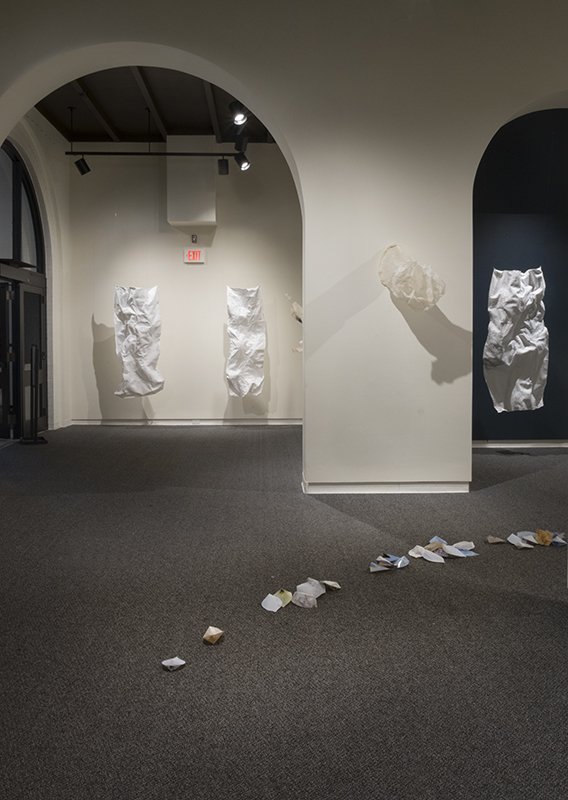
The first pieces in Integument started with weaving paper and experimenting with volume by adding wire. The overlapping strips allowed for more than one idea to intersect on a single plane while also disrupting the continuity of design. The wire provided a skeletal frame to hold form.
The desire for dimension continued with shaping paper infused with encaustic wax. This saturation process stiffens the material while also creating a translucent layer - a barrier that implies something below or beyond. When folded and contoured, the waxed paper records scars.
The folding of meaning was carried forward in the fabricated seeds, where photographic moments meet words in hand-sewn capsules. And finally, actual integumentary materials - hog casings and wool - were shaped into various forms and then released into the room.
The Integument exhibit at Duluth Art Institute was made possible in part by a grant from Arrowhead Regional Arts Council. This activity is made possible in part by the voters of Minnesota, thanks to a legislative appropriation from the arts and cultural heritage fund.